
Last week, I told you about a client who lost twelve years of origination credit to a colleague who did not wait for anyone to hand it to him.
The lesson from that story is not (just) that she should have been more aggressive, or louder, or more political. The real lesson is that she was operating on a model of recognition that BigLaw was never designed to deliver. She believed that consistent, excellent work over a long period of time would be seen, remembered, and rewarded. She believed the relationship she had built with her mentor was a record that would speak for itself when the time came.
It wasn’t. And it didn’t.
This week, I want to give you the tool that changes that dynamic before you are standing at a retirement party, discovering what the last twelve years were actually worth in terms of origination credit.
This reframe will change everything about how you approach credit and visibility in BigLaw.
When your contributions are invisible to the people who evaluate you, that is not a fairness problem. It is a legibility problem.
A fairness problem requires someone else to change. A legibility problem requires you to supply information, intentionally and proactively. Those are very different situations, and only one of them is within your control.
The partners and practice group leaders who evaluate you are managing their own clients, their own billing demands, their own business development pipelines, the political landscape of a large and complicated institution, and their own unique and evolving personal lives. They likely are not tracking your contributions with the specificity that a fair evaluation requires.
That is not personal. BigLaw was not designed to track your contributions. It was designed to service clients, generate revenue, and manage risk. Individual visibility is not a byproduct of that system. It is something you have to engineer yourself. It is a system where the people who make their work legible to decision-makers get evaluated on what is known, and the people who do not are evaluated on what can be inferred. Which is a much thinner record.
The attorneys who advance are not always the ones who did the most work. They are frequently the ones whose work was the most visible to the people who made the decision, at the time the decision was made. Perception in this sense matters here in a way that can feel deeply unfair.
That is still true regardless of how you feel about it.
So. The tool.
The Strategic Impact Update
The Strategic Impact Update is a short, proactive, written communication sent directly to the one to three people whose opinions most directly shape your trajectory: your supervising partner, your practice group leader, a sponsor with direct influence over your candidacy. It is sent monthly, or within 48 hours of completing a significant deliverable. It is not a reply to an existing email chain. It is a standalone communication, initiated by you, that documents what you specifically did and what it produced.
It contains three things: one to three contributions stated in active voice with a specific outcome attached to each, one forward-looking sentence about where your focus is next, and nothing else.
In practice, it looks something like this:
“Wanted to give you a quick update on my work this month. I led the due diligence process on the Henderson matter and identified three material issues that allowed us to renegotiate the representations before closing. I also managed the Alvarez summary judgment briefing through filing and handled the client communications throughout. Next month, I am focused on deepening the relationship with the contact from the March pitch. Happy to connect if helpful.”
Three to five sentences. Sent once a month. To the people who will be in the room when your name comes up.
Notice what it does not do. It does not hedge. It does not say “I helped with” or “I was involved in” or “the team worked on.” It states facts, in an active voice, with a specific outcome attached. It names your role precisely. And it lands directly with the people who need the information, before the annual performance review cycle asks everyone to reconstruct a year of work from memory.
I know the objection. This feels like bragging. It feels like drawing attention to yourself in a way that contradicts every professional norm you hold dear (which holds that good work speaks for itself and that people who talk about their own contributions are self-promoters at best and insufferable at worst).
Let’s dismantle that. The truth underneath that discomfort is that the Strategic Impact Update is not self-promotion. It is case management for your career. It does not “brag,” or manufacture an impression. It simply supplies the accurate information that a fair evaluation actually requires. Without it, you are asking decision-makers to advocate for you based on a record they are not maintaining and don’t even realize is missing.
The norm that good work speaks for itself wasn’t built for BigLaw. It was built for a smaller, slower, more relationship-dense environment than the one in which you are operating. In a firm of hundreds of attorneys, the work speaks for itself to the partner who supervised it, and essentially no one else. Because of how they have been socialized, women are often the least comfortable with this kind of proactive self-advocacy. The internal resistance is real, it is understandable, and it is also the most expensive professional habit you can have in BigLaw. The attorneys who are most reluctant to claim credit are frequently the ones who most need the record. If you have been waiting for someone to notice without being told, you are not being modest. You are being invisible. And invisibility, in a partnership track environment, is not a virtue. It is a liability.
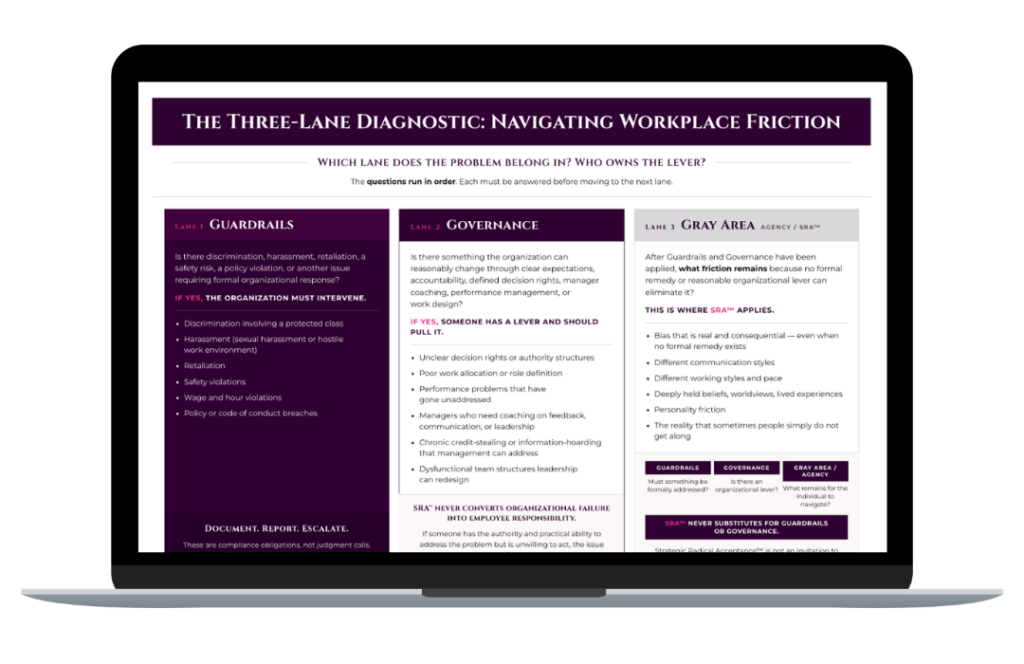
This is Strategic Radical Acceptance™ in practice. You cannot control whether a busy partner remembers what you did eleven months ago. You can control whether they have a bulletproof, written record of it. You observe the system’s flaw, you name the lever (legibility), and you claim it. That is where your energy belongs.
A few practical notes on implementation.
Monthly works for most practices. If your work involves long-cycle matters with few discrete milestones, tie the updates to matter events rather than calendar dates: when a significant brief is filed, when a deal closes, when a client relationship advances. Consistency matters more than cadence. Done once, this is an email. Done twelve times, it is a record.
The recipients should be the two or three people with the most direct influence over your evaluation, your staffing on matters, and your access to clients. Think about who is in the room when your name comes up and whose opinion of you carries weight. Send it to those people. Not to everyone: a broad distribution turns a professional communication into a performance, and people will notice the difference.
Start before you think you need to. The attorneys who implement this practice six months before their review have a fundamentally different conversation than the ones who try to reconstruct their year at self-evaluation time, only. By then, the record is already in front of the decision-maker(s). The review becomes a confirmation rather than a revelation.
The Strategic Impact Update is one way to make your work legible before someone else has to reconstruct your contribution from memory. But visibility is only one part of your position inside the firm. You also need to know who will advocate for you, how decisions actually travel, where your business-development trajectory is headed, and which parts of your strategy are grounded in evidence rather than assumption.
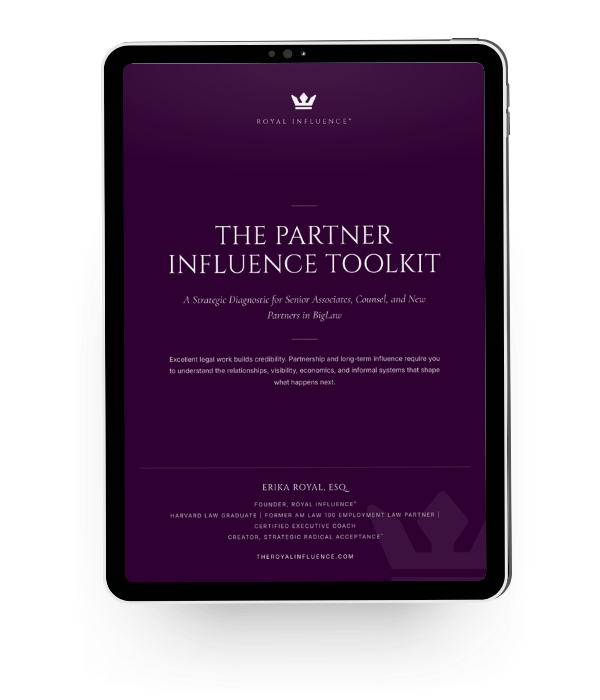
That is what the Partner Influence Toolkit is designed to help you assess. It is a strategic diagnostic for senior associates, counsel, and newly promoted partners who want a clearer view of how they are positioned inside the firm and where to focus next. It includes the Strategic Impact Update, along with tools for examining your relationships, visibility, business development, institutional intelligence, and agency, and turning what you learn into concrete next moves.
Stop hoping your work speaks for itself. Build the record, read the institution, and decide what needs to happen next.
Strategic Radical Acceptance™. This is not Resignation. This is Liberation. And it’s Strategy.