
The lunch was already annoying before anyone asked me anything.
It was an associates’ lunch on the “path to partnership,” and the speaker was a recently elevated partner. His message, repeated with great confidence, was that his promotion had been a “no-brainer.” He had the clients. He had the hours. What more was there to say?
Quite a lot, as it turned out. Just not by him.
I was a ninth-year associate. At some point, a male associate, a year or two junior to me, spoke up. He said he expected his own future partnership application to be pretty strong. Then he mentioned being grateful that his wife stayed home with their children, thus allowing him to bill upwards of 2,100 hours a year. At the time, I was struggling to make the required 1,900 minimum.
Then, for some reason, he turned to me and said, in front of the whole room, “You’ve been here a while. Why aren’t you a partner yet?”
Without thinking, I replied, “You have a wife. I am a wife.”
The Question Behind the Question
In fairness, he’d done most of the work on that answer for me.
I don’t think he meant anything by it. He was curious. But he realized his error as soon as the question left his mouth. Every woman at that lunch reacted, and he felt it.
He had two or three very young children. I had two daughters, ages one and three. On paper, we were in the same season of life. In practice, he went home to someone who made his 2,100 hours possible. I went home to be that person.
And that was before counting the part no spouse can take off your plate. By then I’d been through two pregnancies and two recoveries, and before that year was out I’d be pregnant with my third.
To his credit, he knew exactly what his wife’s support was worth. He just hadn’t connected it to anyone else in the room.
"They Each Had Their Reasons"
When I started at the firm, the associates ahead of me looked roughly evenly split between men and women. The further up I went, the fewer women there were, and the drop was steep. My mentor from my summer associate days, a litigator whose busy career looked satisfying from where I sat, left shortly after her first child was born. By then I’d moved offices, and we weren’t close enough for me to ask why.
Somebody did ask about the pattern once. In a meeting, our litigation section leader was asked why so many women had left a particular office. His answer was that “they each had their reasons.”
They did. They also all had the same office in common. Just a coincidence, I guess.
The Menu
A lot of the women I knew were trying to figure out how a demanding legal career and the family they wanted could fit into the same life. Even contemplating it was stressful. Some started planning their departure even before anyone at the firm had asked them to change anything.
The menu seemed to offer limited options. They could leave. Or they could request a flex-time arrangement, accepting lower pay in exchange for fewer required hours.
How that trade worked out depended almost entirely on whose work you did. Some women worked for partners who were supportive enough that they never felt the need to make it at all. Others worked for partners who were less understanding, and for them, flex-time often meant working close to full-time anyway, now for less money. The women who held the line and actually worked the reduced schedule paid a different price. Some partners started to wonder how committed they were and whether they could be relied upon for a matter.
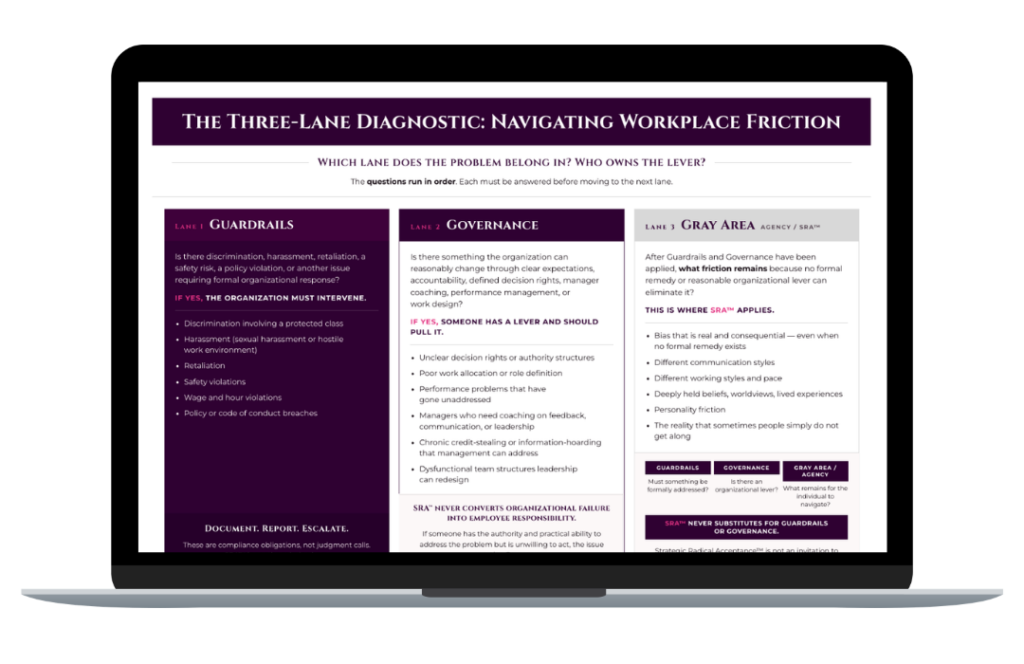
Could the firm have written a better policy? Sure. A policy can set your hours and your pay. But a written policy can do little about what a partner concludes about you (consciously or otherwise) when you leave at five. So much of life in BigLaw runs on how individual partners like to work and what they decide about people, and no one person controls all of that. What looked like a Governance problem mostly landed in the Gray Area.
I don’t fault anyone for what she chose from that menu. Deciding in advance was often an accurate read of the partners they worked for. Trying to imagine how you’ll manage a demanding career and the family you want can be exhausting before any of it has happened. Leaving can start to feel like the one decision that would let you breathe. I understood that pull. I just wanted to give myself a chance to find out whether I could have both before deciding that I couldn’t.
Declining to Order
I decided I wasn’t going to concede a fight the firm hadn’t picked yet. That meant turning down the whole menu. I stayed full-time, and I didn’t ask for reduced hours.
Then I made sure the firm knew what I intended. I said, in my evaluation and anywhere else it was relevant, that I was the breadwinner and my family depended on my income. I used my self-evaluation to show I was still growing and creating new opportunities for myself. I also took on leadership roles inside the firm. People planning their exit don’t usually volunteer to run things.
The Year I Applied
The firm had a rule. By your tenth year, you applied for partner or you applied for senior counsel. Nobody stayed an associate past year ten.
Toward the end of 2007, my ninth year, I decided I’d apply in 2008. The bare minimum was making my 2007 hours, so that fall I went through every one of my matters chronologically to make sure the work I needed would be there.
In early December, I found out I was pregnant with my third child, due the following August.
I told no one at the firm. The 2007 hours closed a few days into January, and I’d made them (with ten to spare!). The partners I worked for knew partnership was my priority, and together we agreed on a plan for me to apply. Only after that plan was set did I tell them about the baby.
I had great relationships with the partners I worked with, but I still worried about the assumptions a pregnancy could set in motion at that stage, the kind nobody ever says out loud. The kind people might not even realize they make. I wanted the firm to evaluate the candidacy I had built before anyone started running a different calculation. That was a strategy that fit my situation. It isn’t a template.
I found out that I’d made partner the first week of December 2008, about three months after my son was born.
What I Accepted and What I Built
I accepted a lot. I couldn’t bill like someone with full-time support at home, and pregnancy and recovery don’t consult the partnership calendar. (The partnership clock tends to run out right around the time that a certain other clock starts ticking pretty loudly.) That was The External. I could complain about it, and occasionally I did, but I couldn’t directly control it.
The Internal was refusing to take myself out of the running, and then building the best case I could for my promotion. Staying worked for me because I knew what it would cost and decided to pay it.
That price isn’t the same for everyone. If you’re one of very few people who look like you, every stumble carries extra weight, and not everyone can afford to wait out an institution that isn’t sure about them. And if what you’re facing involves a violation of law or policy, that’s a Guardrails issue, with different tools to address it.
Staying worked for me because I knew what it cost and decided to pay it.
Saying It in Writing
A lot of the case for my career got made in my annual self-evaluations. It was the one document each year where I got to tell the firm, in my own words, what I’d contributed and where I was headed. For a while, I treated it like a form to fill out. Once I started using it on purpose, it started working for me.
I’m building a short course on writing a self-evaluation that makes your contribution and your trajectory clear to the people reading it. Short video lessons and a workbook will guide you toward a complete draft in your firm’s format. The course includes one 30-minute feedback call with me. If you want feedback before your submission deadline, plan ahead: year-end appointments will be limited.
It’s $497, and enrollment opens October 19. Join the waitlist here and I’ll send you the enrollment link when it opens.
Eight Words
That path to partnership lunch was supposed to teach us how to make partner. The speaker’s answer was “have clients and hours.” The associate’s question made the discussion personal. Ultimately, though, I knew why his path looked easier. I had answered that question at lunch in eight words.
What I wanted to find out was how far I could go with the life I actually had. In December 2008, I had two daughters, a three-month-old son, and my answer.
Enrollment opens October 19. The waitlist is below.