
At some point in the last six years, a lot of people who look like me had the same realization.
No one is coming to save us.
Not as a defeat. As a fact.
And once you accept it as a fact, something shifts.
That shift became real, fast.
In 2020, I was doing two jobs at once.
The first was the one I was trained for. As an employment attorney at an AmLaw 100 firm, I spent most of that year learning everything there was to know about COVID-19—the Families First Coronavirus Response Act (FFCRA), revised OSHA guidance and PPE, evolving state orders—and translating it all in real time for clients whose businesses were in freefall.
That was familiar territory. Hard, but familiar.
The second job was different.
After George Floyd was murdered, something cracked open in corporate America. The phone calls stopped being just about involuntary furloughs and force majeure. They became about race. About what people had never been asked to name at work and were now being asked to name all at once. I was leading those conversations, both as the Chair of my firm’s Black Affinity Group, and for firm clients. Social justice discussions. Race in the workplace trainings. Courageous conversations and difficult dialogues that people had been avoiding for decades, now compressed into Zoom rooms because everything had broken open simultaneously.
I was also a Black woman living all of it while trying to lead others through it.
That part doesn’t usually make it into the professional bio.
Something Had Shifted
2020 felt different. Not just louder. Different.
People who had never paused to consider the daily experience of their Black colleagues were pausing. Asking. Sitting with something uncomfortable without immediately retreating. For those of us who had been navigating these environments for years, carrying the weight of performing excellence while managing the invisible labor of being the “only” in a room, it finally felt like a true reckoning that might actually hold.
I watched institutions “discover” language that many of us had been living for years.
It didn’t hold.
And Then It Snapped Back
By 2024, what was once framed as commitment quietly became liability.
Programs that took years to build were dismantled in weeks. Roles were eliminated. Initiatives were shuttered. And the language used to justify it: “returning to merit,” “focusing on excellence,” “responding to the current legal environment,” communicated something very specific to everyone who heard it.
It communicated that the work was never really about equity.
That, when the commitment became inconvenient, it would be set aside.
That the people who had built it, believed in it, and put their professional credibility behind it could and would be left out to dry.
I’m not going to catalogue who did what. That’s not what this post is for. What I will say is this: the BigLaw capitulation to the executive order pressure of 2025 was, in many cases, proven in the courts to be legally unnecessary. Firms that had the resources to withstand scrutiny chose not to. That was a decision.
And the people most affected by that decision deserve to name what it cost them.
A Structural Truth
The people who benefit from a system are not going to dismantle it. Not because they’re all malicious. But because systems persist for a reason. They serve someone, and the people they serve don’t typically experience them as systems worth changing.
That’s not cynicism. It’s structure.
Systems can change. But they rarely change on the timeline of the individual trying to build a career inside them. And once you see that clearly, you start asking a different question. Not, how do I fix this? But what do I do with my energy while I’m here?
The Gap the Law Cannot Close
Here’s what 22 years of employment defense work taught me.
The situations that drain people most are often the ones that do not fit neatly into a legal claim: exclusion from informal networks, credit that disappears into a “team effort,” feedback that contradicts everything the relationship suggested, politics that predate your arrival and will outlast your departure.
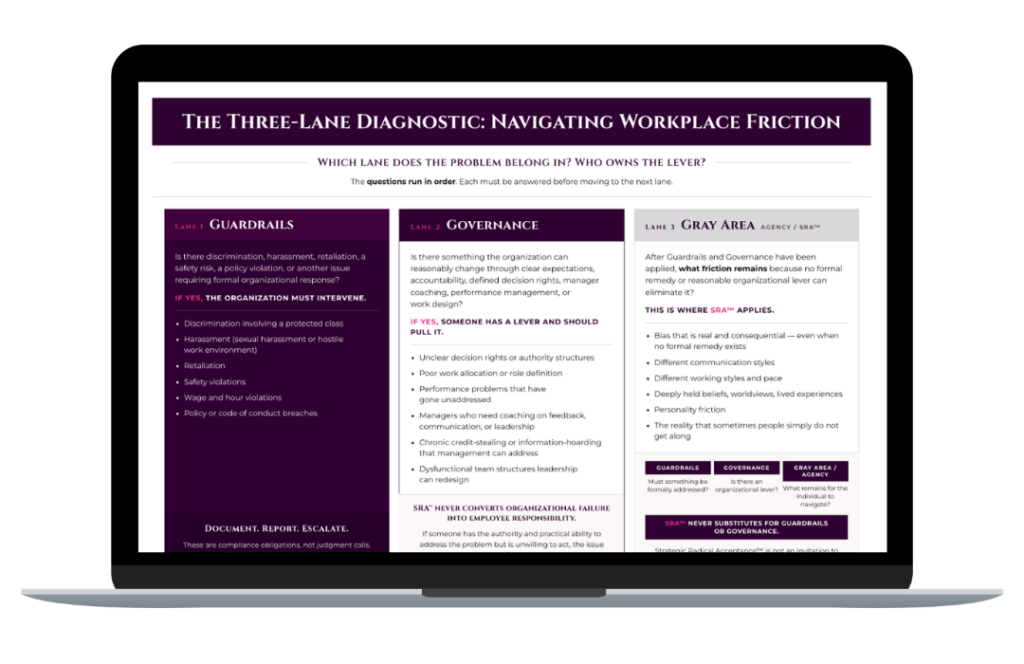
Some of those problems belong to the organization. If there is a real lever through policy, management, accountability, work allocation, or decision rights, the organization should use it. Some may cross a legal line depending on the facts.
But a tremendous amount remains after those questions have been answered. The email you cannot quite challenge. The credit you cannot reliably recover. The assumption someone formed about you years ago. The informal politics no single decision-maker can command out of existence.
Strategic Radical Acceptance™ exists for that remainder: the consequential workplace friction that persists after you have accurately identified what the law can address, what the organization can reasonably address, and what is actually left for you to navigate.
I watched it play out for two decades. People pursuing cases through years of litigation (discovery, depositions, summary judgment, mediation, trial) for situations the legal system was never designed to remedy. The feeling of mistreatment was real. But what the law could do about it was, often, nothing.
And that gap between what people experience and what the law can actually address? That’s where professional capital goes to die.
I watched it happen to others. I watched it happen inside the same institutions I was advising.
So I Built Something
Not because I’d given up on systems changing. But because I refused to watch another generation of underrepresented professionals spend their best years waiting for permission that was never going to come.
Strategic Radical Acceptance™ is the methodology I built to address that gap. It is not resignation. It is not an instruction to smile through dynamics that are working against you. It is not passivity dressed up as professionalism.
It is a framework for doing something much harder: managing your energy, attention, and response strategically inside an environment you didn’t design and can’t single-handedly change, while building the stability and leverage to advance on your own terms.
The premise most professional development frameworks skip is this: the environment is not going to change on your timeline. The bias, the politics, the unspoken rules, the informal networks – those all existed before you arrived. They will require more than your individual effort to shift.
Pouring your best energy into trying to control what you do not actually control is expensive.
And it keeps you from building what actually moves you forward.
This framework sits at the intersection of three things I know from the inside: what employment law can and cannot do for people navigating workplace friction, what it costs underrepresented professionals to move through institutions that weren’t built for them, and what it actually takes to build professional capital when the rules are unspoken and the access is unequal.
It wasn’t built from research. It wasn’t built from a safe distance.
It was built from 22 years inside the rooms where these dynamics play out.
The Stakes Are Not Abstract
I want to be direct about why this matters to me, personally.
I am a first-generation professional. My first year in BigLaw, I made more money than either of my parents ever had. That is not a small thing. That is a life-altering thing. A family-trajectory-altering thing.
The professionals I work with (many of them first-generation lawyers, people who are the first in their families to access this level of opportunity) are sitting on that same potential. These roles can build generational wealth. They can open doors that stay open for the generations who come after you.
That opportunity, that potential, doesn’t survive indefinitely on a diet of misallocated energy.
Every moment spent trying to change someone else’s bias, or their limited imagination, or a worldview built over decades before you arrived, is a moment that isn’t spent building the leverage, the relationships, and the reputation that make these opportunities pay out the way they’re supposed to.
The opportunity is real. The window is not unlimited. And the people who benefit most from your distraction are not the ones whose futures depend on your success.
No one is coming to save us.
That used to feel like defeat.
Now it feels like a starting point.
The moment you stop waiting for the institution to become something it has consistently shown you it is not, you can take your energy back. And energy, directed strategically, is what changes trajectories.
That is what SRA™ is built to do.
In the next post, I’ll show you exactly why most of what drains professionals in these environments isn’t legally actionable, and what that means for where you put your energy. Because before the framework makes sense, the legal reality has to be clear.
Strategic Radical Acceptance™. This is not Resignation. This is Liberation. And it’s Strategy.