
What I Watched From the Other Side of the Table
I spent 22 years practicing employment defense.
That means I was not the attorney advising employees whether they had a case. I was on the other side, defending employers against claims that had already been filed, already named, already set in motion. My job was to take those claims through the full litigation process: discovery, depositions, motions practice, summary judgment, and sometimes trial.
What I watched, repeatedly, from that vantage point was this:
- People who genuinely believed they had been treated poorly;
- People passed over for opportunities they were more qualified for;
- Employees excluded from rooms where decisions were made about them;
- Individuals given feedback that contradicted everything their day-to-day relationships had suggested
I watched them pursue legal claims for years at significant personal cost, only to have their cases dismissed at summary judgment, returned with a defense verdict at trial, or settled for amounts that left them with shockingly little once their attorneys collected their fees and costs.
The feeling of mistreatment was legitimate. What the law could do about it, frequently, was nothing.
That gap between genuine grievance and actionable claim is where much of the workplace pain I saw actually lives. And the problem is that nobody tells people this until they are already deep in the process: emotionally invested, professionally exposed, and carrying the weight of having formally named something they now have to see through to the end.
That gap is also where Strategic Radical Acceptance™ was built to operate.
What Changed After 2020
The 2020 moment shifted something in the employment relationship. Not in the law, but in expectations.
In the face of social justice and return to office pressures, organizations made commitments. Some were sincere. Some were performative. Most were somewhere in between. But the message to employees was consistent: bring your whole self to work, expect to feel safe, expect to be seen, expect your organization to show up for you in ways that go beyond the transactional.
Those invitations created expectations that employment law never contemplated and that most organizations were never equipped to deliver.
The fact is that the law does not require your manager to communicate in a style that works for you. It does not require your organization to ensure you feel included, or that credit is distributed equitably, or that feedback is timely and consistent, or that workplace politics are fair. What it requires, in broad terms, is that your employer not discriminate against you based on a protected class, not subject you to unlawful harassment, and not retaliate against you for protected activity.
That is a meaningful set of protections. It is also a much narrower set than what many employees now believe they are entitled to. That gap in understanding is creating friction at every level of organizational life.
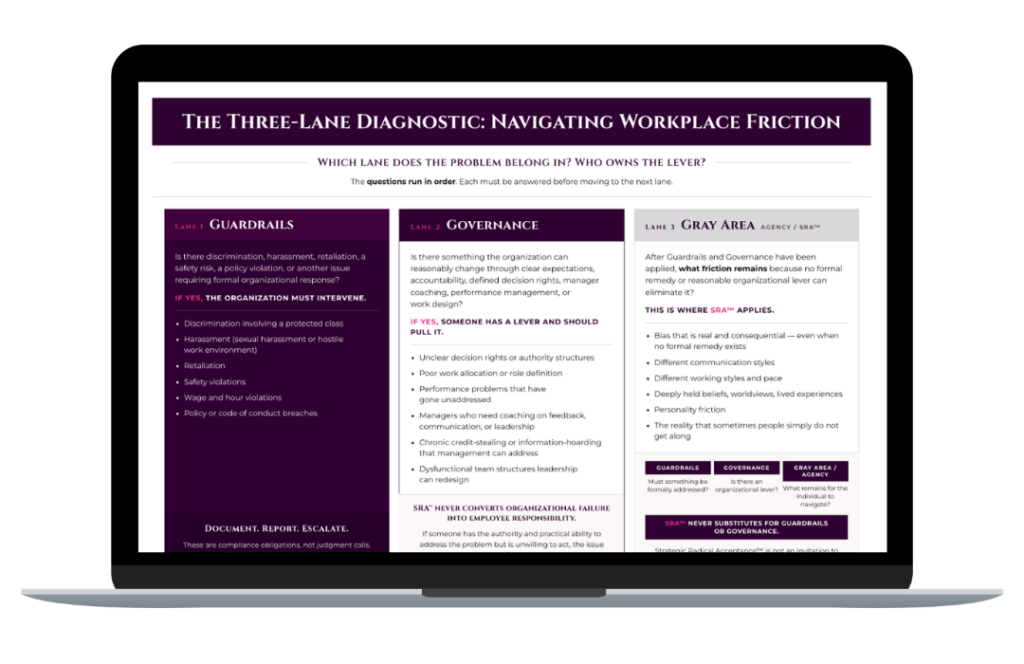
Between the Guardrails and the Gray Area sits a middle lane: Governance. Some workplace problems are not legally actionable but are still organizational problems the organization has both the ability and the responsibility to address. Unclear decision rights, poor work allocation, managers who have never been coached on giving useful feedback, patterns of credit-stealing that leadership can interrupt. In organizations with functional HR and defined accountability structures, those problems have a lever. The organization should pull it.
In certain professional environments, though, that lane is practically narrow. Where authority is genuinely diffuse, no single person may possess the ability to resolve what would otherwise be a Governance problem. What looks like organizational failure to act may in fact reflect organizational inability to act. That distinction matters, because it changes what belongs to the individual to navigate.
Employees often present Gray Area situations as though they belong in Guardrails or Governance. Not because they are being dishonest. Because no one gave them the framework to tell the difference.
What the Law Was Built For, and What It Wasn't
Employment law was built to protect workers from discrimination based on protected characteristics: race, sex, age, national origin, religion, disability, and others depending on jurisdiction. It was built to prohibit unlawful harassment and to protect employees who report violations from retaliation. These are the Guardrails, and they are serious, enforceable, and non-negotiable.
What employment law was not built to do is a longer list.
It was not built to guarantee that your workplace feels fair. It was not built to ensure your manager gives you useful feedback, or any feedback at all. It was not built to require accurate attribution of your contributions. It was not built to mandate consistent treatment, resolve personality conflicts, or protect you from a leader who communicates poorly, plays favorites, or simply doesn’t like you. To put it bluntly: Title VII is not a civility code.
Those experiences are real. The harm they cause is real. The professional capital they cost is real.
And often, they are not legally actionable.
The law does recognize that patterns matter. A documented, cumulative pattern of exclusion or differential treatment tied to a protected class can eventually cross into Guardrails territory. But isolated interpersonal friction, even when it is persistent, damaging, and genuinely unfair, does not necessarily live in the Guardrails. Some of it belongs to Governance: problems the organization has both the ability and the responsibility to address through clearer expectations, better accountability, or managerial intervention. What remains after those organizational levers have been identified and applied is the Gray Area. And the Gray Area is vast.
This is not a comfortable truth. It is, however, a clarifying one. The professional who understands it can make different decisions about where to invest their energy. The organization that understands it can build different infrastructure for how employees navigate it.
The Cost of Getting This Wrong
When Gray Area friction is misidentified as a Guardrails violation, everyone loses.
For the individual, pursuing a formal remedy for a Gray Area situation is expensive in every sense of the word:
- Financially, if legal counsel is involved.
- Emotionally, because naming and formalizing a grievance requires revisiting and re-experiencing it at every stage of the process.
- Professionally, because the workplace relationship, and sometimes the professional reputation, rarely survives intact.
- Practically, because Gray Area situations frequently don’t resolve the way people hope, because the formal process was not designed for that territory.
The professional who spends eighteen months in a formal complaint process over a situation that lives in the Gray Area has spent eighteen months not building the leverage, the relationships, and the visibility that would actually move their career forward. That is an enormous cost. And it is largely invisible until it has already been paid.
For the organization, when employees don’t have the tools to navigate Gray Area friction, every difficult interpersonal situation becomes a potential escalation. Ordinary disagreements are more likely to become HR escalations. Difficult feedback is more likely to be framed as an organizational problem requiring intervention. The bandwidth drain on HR, legal, and leadership is significant. In organizations where management has functional levers, some of that friction belongs to Governance, not to individual navigation. The three-lane question is always: who owns the lever? In certain professional environments, the honest answer is often that no single person does.
Corporate America has a massive structural blind spot: they spend millions of dollars training their workforces on the tiny fraction of behavior that crosses a legal line, while leaving people completely defenseless against the everyday friction that is simply exhausting. A meaningful share of HR and leadership bandwidth can be consumed by situations that formal legal processes were never designed to resolve.
In short, we have taught employees how to spot a lawsuit, but we have given them zero tools to navigate a Tuesday.
This is not hypothetical. It is what I watched happen for two decades.
What Work Actually Is
Something got lost somewhere between 2020 and now, and it’s worth naming directly.
This tension is showing up again in the reaction to Emma Grede’s book, Start With Yourself. Grede has drawn criticism for arguing that businesses ultimately exist to serve their customers, fulfill their missions, and make money, and that what is best for the business will not always align perfectly with what every individual employee wants.
People are reacting viscerally because that argument collides with the expectations many organizations helped create after 2020. Employees were encouraged to expect workplaces to provide belonging, psychological safety, alignment with personal values, and a level of institutional care that went well beyond the traditional employment bargain.
From an employment law and self-preservation perspective, I think Grede is right about the underlying structural reality.
Companies are organizations with business objectives. They cannot guarantee belonging, fulfillment, fairness, or conflict-free environments. The employment relationship carries real obligations, including compensation for work and protection from unlawful treatment. But it was never a promise that your manager would be emotionally intelligent, that your colleagues would treat you fairly, that credit would always flow where it was earned, or that organizational politics would resolve in your favor.
Understanding that reality matters because expectations shape strategy. If you expect the organization to solve every consequential workplace problem, you will keep looking for an institutional lever even after you have established that none exists.
That is where the Gray Area begins.
The professional who understands what work can reasonably provide can redirect energy toward what remains available: opportunity, compensation, skill development, relationships, influence, and a platform from which to build the career they actually want.
That is the strategic move.
Where This Leaves You
Post 1 of this series named the problem: the 2020 moment collapsed, the commitments were walked back, and the infrastructure that was supposed to support underrepresented professionals was never built.
This post names the legal reality underneath that problem: most of what people experience in these environments, however real and however costly, does not meet the threshold for legal remedy. Some of it belongs to Governance, where the organization has a lever and should use it. What remains after those organizational responsibilities have been met is the Gray Area, and that is where most professionals are left standing without a map. And without a framework for navigating it, professionals spend their most valuable resource on battles the legal system was not designed to resolve.
That is the agitation. Here is the resolution.
Knowing where the law stops is only useful if you have a framework for what comes next. Employment law tells you what you don’t have to tolerate. Strategic Radical Acceptance™ (SRA) tells you how to navigate everything else.
If you are ready to see exactly what SRA™ is, how it works mechanically, and what it looks like when it is deployed for the individual and the organization, I have laid out the entire framework here on the Royal Influence website.
Strategic Radical Acceptance™. This is not Resignation. This is Liberation. And it’s Strategy.