
For most of my time at my law firm, I was not a passive participant in its diversity and inclusion efforts.
I was a Women’s Initiative Rising Star. I spent five and a half years as chair of the Black Affinity Group. I was a member of the firm’s Diversity Council. I led conversations, mentored junior attorneys, and invested real time and real energy in programs I believed were building toward something genuine. I did not participate because it looked good on a bio or because someone asked me to show up. I participated because I believed the institution meant it.
That belief was the condition of my investment. If I had thought those efforts were performative, I would not have given them what I gave them.
What I watched happen in the early months of 2025 changed my understanding of what that investment had actually been.
When this administration began pressuring law firms, the affinity groups disappeared. The website was scrubbed. Programs that had been built and staffed and celebrated for years were quietly, efficiently dismantled. Not over months. Over weeks.
I had always sensed a hesitation underneath those efforts. A ceiling that nobody named. A place where the commitment seemed to thin out before it reached anything structural. I had interpreted that hesitation charitably, as a work in progress, as the friction of a large institution moving slowly toward something it genuinely intended.
The speed of the reversal told me I had been wrong about that.
What the dismantlement revealed was not that the firm had become something different under pressure. It was that the pressure had made visible what had always been true. The hesitation was not uncertainty. It was the outer boundary of a conditional commitment. The programs existed while the conditions supported them. When the conditions changed, the commitment went with them.
That is not a story about bad people or a bad firm. It is a story about what institutions are.
What a Company Actually Is
A company is not a community. It is not a family. It is not an entity that holds your professional development, your sense of belonging, or your experience of being seen and valued as a core organizational objective.
It is a collection of people, each of whom is living in the same complicated, divided, pressure-filled world as everyone else, organized around a business objective. It generates revenue. It manages risk. It services clients or customers or both. The people within it may care about you deeply, and those individual relationships are real and worth investing in. But the institution itself is not structured around your flourishing. It is structured around its own survival and success.
This does not make the social contract of employment meaningless. That contract is real and worth defending. You contribute value, you are compensated, you are protected from unlawful treatment. Those are meaningful commitments and you are right to hold institutions accountable for them.
But that contract was never a promise that your manager would be emotionally intelligent. That credit would flow where it was earned. That the people in power would examine their assumptions before making decisions that shape your career. That your sense of belonging would be treated as an organizational priority when the political winds shifted.
What happened in 2020 was that organizations, under enormous social pressure, made promises that exceeded what the social contract of employment was ever designed to deliver. They used the language of community and family and unconditional belonging. And the employees who heard those promises, particularly the underrepresented employees who had the most to gain from them, believed them. Because the people making them often believed them too, in the moment, with the best of intentions.
The problem was not insincerity, in most cases. The problem was that the commitments were made in the language of community without the infrastructure of community. And when the conditions that created the pressure to make those commitments changed, the commitments changed with them.
Because that is what institutions do. They respond to conditions.
What the Clarity Actually Gives You
I want to be precise about what I am not saying.
I am not saying the programs did not matter. They did. The relationships built inside those affinity groups were real. The mentorship was real. The visibility those programs created for junior attorneys was real. Individual people within those institutions cared genuinely, and that care produced real outcomes for real people.
What I am saying is that the institutional commitment was always conditional, and understanding that conditionality is not the same as being defeated by it.
There is a version of this realization that produces bitterness: I gave years to this and it meant nothing. I understand that version. I felt it.
But there is another version that produces clarity: I now know exactly what I was dealing with, which means I know exactly what to expect and where to direct my energy from here.
The professional who understands what a company actually is can stop waiting for it to deliver what it was never designed to provide. They can stop measuring the institution’s investment in their belonging as a proxy for their own worth. They can extract what the environment genuinely offers, which is significant: opportunity, compensation, skill development, access, and relationships with individuals who care about them specifically. And they can stop spending energy on the gap between what was promised and what the institution was always structurally incapable of delivering.
That is not resignation. It is a recalibration of expectations against reality.
And in my experience, it is one of the most liberating professional shifts a person can make.
What This Means for How You Navigate
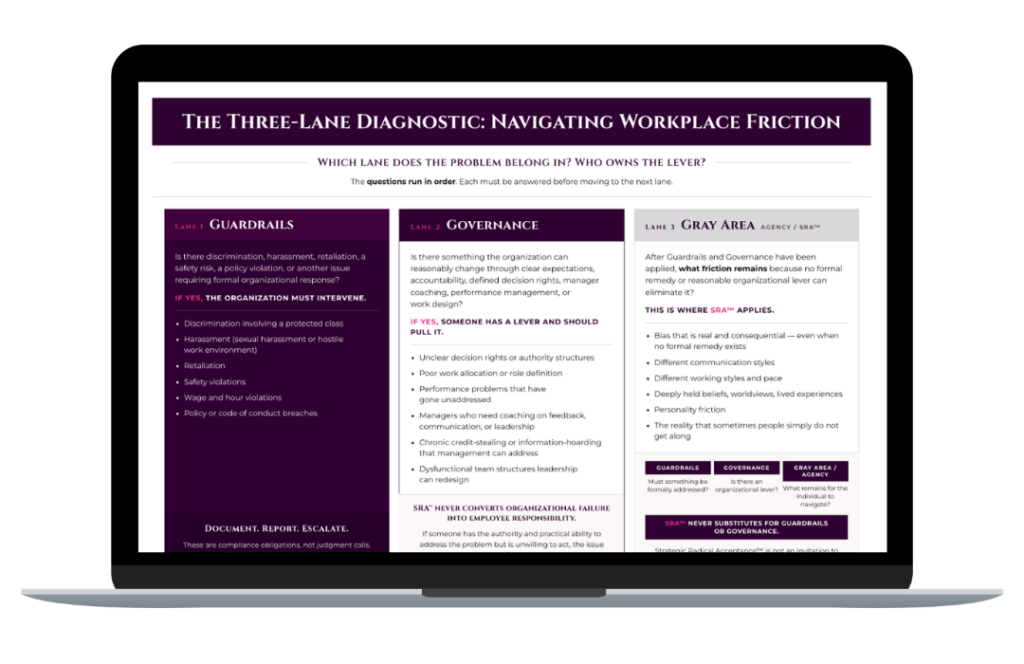
Strategic Radical Acceptance™ was built, in part, for exactly this moment. Not the moment of dismantlement, which you cannot control. The moment after, when you have to decide what the dismantlement means and what you do next.
The SRA™ framework asks you to do three things with this information.
Observe it clearly. The institution showed you what it is. File that as accurate data about the environment you are operating in, not as a verdict about your worth or a reason to stop investing in your own career.
Decide what is within your direct control. You cannot determine whether your organization’s commitment to inclusion is contingent or unconditional. You can determine how much of your professional energy goes toward institutional expectations versus building the leverage, relationships, and visibility that belong to you regardless of what the institution decides next.
And hold onto what is yours. The skills you built. The relationships you cultivated. The clients who know your work. The reputation you built inside and outside the firm. None of that went with the affinity group when it was scrubbed from the website.
And there is one more thing worth saying directly.
You do not need the organization’s permission, enthusiasm, or participation to continue doing what you believed was right when you were doing it inside the formal programs.
The junior attorney who needs a mentor still needs one. The person who needs a sponsor in a room you have access to still needs one. The voice for equitable treatment in a hiring decision, a staffing conversation, or a client pitch is still worth raising, whether or not there is a committee structure behind it.
The institution withdrew its formal commitment. It did not withdraw your access to the people around you, your influence in the rooms where you sit, or your capacity to act on your values through your own choices and your own relationships.
What was real about those efforts was never the program. It was the people in them, and what they chose to do for each other.
That does not require an affinity group to continue.
They can dismantle the program. They cannot dismantle you.
Strategic Radical Acceptance™. This is not Resignation. This is Liberation. And it’s Strategy.