
I was there.
I had gone along for moral support, something associates do for each other when an important matter is on the line. My friend had litigated the case from the beginning, on her own. She had done the research, built the record, and prepared the argument. So, when she stood up to argue the summary judgment motion, she was ready.
The relationship partner was in the courtroom that day, too. She had known he would be. What she had not anticipated, I think, was what would happen because he was there.
He began interjecting during her argument. Not once, not as a single correction, but repeatedly, in a way that built over time. I was sitting in the room watching her, and I could see what was happening to her as he spoke. She had started the argument steady, but with each interjection she had to find her footing again. I saw her start to question the argument she’d spent weeks preparing. His interjections began to seem less like additions and more like a running commentary on whether she was handling it correctly.
Finally, the judge said: “who is arguing this, you or her?”
He said: “I am, your Honor.”
And that was the end of it.
What he did, and what he did not do
I want to say clearly what he did and did not do, because I think the distinction matters for everything that follows.
She had prepared that case. She had started that argument and was in the middle of delivering it. If he’d had concerns about her preparation, there had been other options. He could have met with her beforehand and gone through the arguments. He could have sat with her while she practiced. He could have told her directly, before they walked into that courtroom, that he intended to handle the argument himself. All of those conversations would have been uncomfortable, but they would have also been honest. Instead, he just showed up, the interjections accumulated, and, when the judge asked the question, he answered it.
At worst, what he did was to deliberately ambush and humiliate her in front of the judge. At best, it was a partner so focused on the client’s outcome that he never fully considered what his presence and his interjections were costing the person he had trusted with the case. I cannot tell you which it was. And, either way, I am not sure it matters, because, in the moment, the harm to her was the same.
The harm was not only emotional. She was interrupted and destabilized during a live performance she had prepared for. She was publicly displaced in front of the judge and the client. She lost an advocacy opportunity she had earned. And she absorbed all of that cost while he retained the client relationship and walked out with a result he was satisfied with.
She was not wrong to be hurt by it. She was not wrong to be angry.
He called me afterward
After it was over, he called me.
He wanted to know if I thought he had done something wrong. He told me she had been doing fine. He said, however, that he felt he had more knowledge of the client and its operations and that he could better handle taking the argument where it needed to go. He was not defensive, exactly. He seemed to (kind of) want to understand whether what he had done was a problem.
I told him that she had prepared for a very long time and that he had undermined her by taking over the argument the way he did.
He heard what I said. I do not know what he did with it. What I know is that, in his version of what happened, he had stepped in for legitimate professional reasons. The client was well served. The motion was argued the way he wanted it argued. The harm to her was real, but it was not part of the calculation he had made, and when I described it to him, it seemed to land as something he had not previously considered at all, rather than something he had weighed and dismissed.
Nothing in that conversation suggested that he had set out to harm her or that he was pleased by what had happened. He had moved on, and he had a rationale that felt sound to him. The gap between his experience that day and hers had not registered until someone described it to him directly.
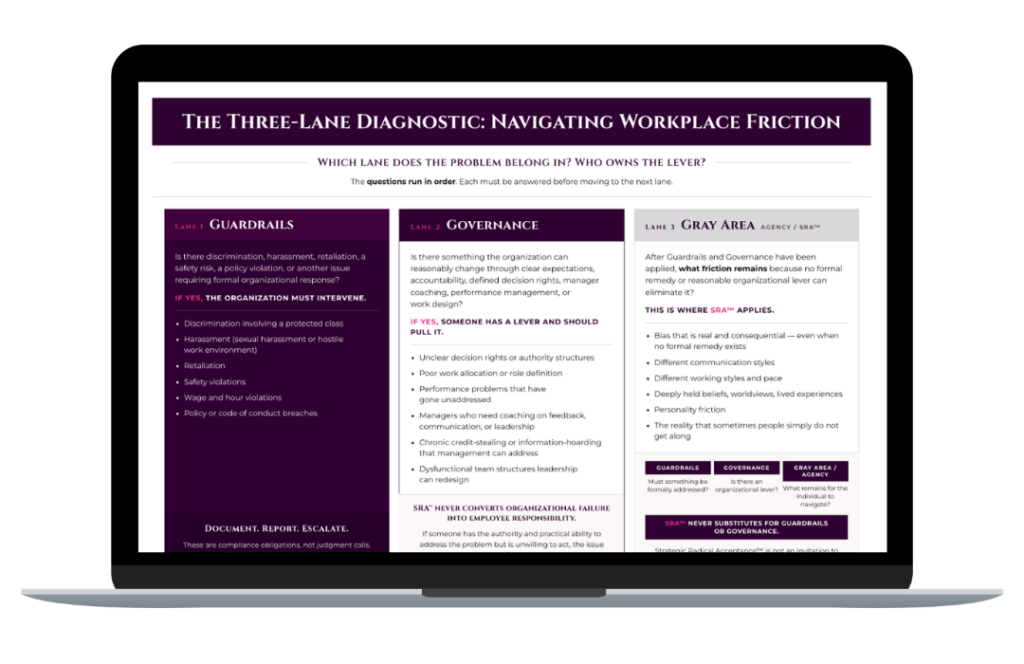
This is what I mean by harm that does not require a villainous motive to produce a serious result. He may have acted selfishly, carelessly, or thoughtlessly. But we do not need to settle the question of his character to understand the impact of what he did. And that is also what makes it a Gray Area harm. It was not illegal. It did not violate a written policy. BigLaw does not have a formal process to address “partner took over my argument.” And yet the professional consequences for her were real: a lost opportunity, shaken confidence, and a decision about her career that she made reactively rather than deliberately.
The anger was not the problem
Over the months that followed, I saw what happened when her reasonable anger became her “strategy.”
To be clear: her anger was not incorrect. It registered accurately that something had been taken from her without warning, and without apology. That is exactly what anger is for.
The problem was not that she felt it. The problem was what came next, or rather, what did not. She did not confront him. There was no formal process to invoke. He had exercised subjective judgment about a client matter, and BigLaw is built to allow exactly that. So she made the decision that felt like the only one available to her: she would not work with him again. And she stopped there. In the absence of a process, a plan, or a conversation, her anger narrowed the field to one move. Once she made it, she moved on and let time do the rest.
Given what happened, I understood that decision completely. But he had a relationship with a significant firm client and provided work to a lot of associates in the office. The decision to avoid him removed her from a stream of opportunity that she did not fully think through. Avoidance as an immediate protective response made sense. Avoidance as a permanent, unexamined professional policy had a cost she never calculated, because the anger did not generate that question.
Naturally, he continued his career without interruption. Whatever he took from that day or from his conversation with me, it was not reorganizing his professional life the way what happened in that courtroom had reorganized hers.
The cost of organizing around a villain
This is the part I want to focus on, because I have seen it play out too many times to treat it as an individual failure.
When someone becomes the villain in your professional story, your power becomes contingent on them. The resolution you are waiting for lives inside their behavior: they need to acknowledge what they did, or apologize, or be held accountable in some way that closes the loop for you. Until that happens, the situation stays open. And, to be clear, you are the only one keeping it open, because they stopped thinking about it long ago.
Let me be precise about what I mean by the villain narrative, because I am not saying the harm was not real or that the anger was not warranted. The villain narrative is something more specific: it is the version in which the person who caused the harm becomes both the explanation for what happened and the necessary source of its resolution. As long as that version is operating, your next move depends on something he does. And he is not going to do it.
The villain narrative feels like clarity. It locates the problem, assigns blame, and suggests that a solution exists: if the villain would change, or leave, or face consequences, the situation would be resolved. The problem is that none of those things are within your control, and while you are waiting for them to happen, you are not making any moves of your own. He is effectively running your calendar without knowing it, because every decision you make has to account for where he is and how to avoid him.
Setting down the narrative
Setting down the villain narrative is not the same as deciding he was right. It is not forgiveness, and it is not a revised assessment of his conduct. What he did was wrong. That does not change.
What changes is what you keep asking yourself.
The villain narrative asks: what should he have done differently, how can he make it right, and when will he be held accountable for what he did instead? Those questions belong to you but the answers do not, because the answers require him to do something.
The other version asks: given what happened, what do I do now? That question and its answers belong entirely to you. It produces different options. In my friend’s case, those options might have included deciding deliberately whether the work he offered was worth the cost of navigating him, and if so, what she needed to have in place before she did it again. What she would ask before she took another case for him. Whether a mentor or sponsor could help shape how she was staffed going forward. Whether she could rebuild the advocacy opportunity she had lost through other matters, with other partners. Whether avoiding him was the right call, on reflection, or just the most immediate one.
She might still have decided not to work with him again. That could have been the right decision. The difference is between withdrawal as a reaction and withdrawal as a strategy. She might have reached the same conclusion either way. But then she would have chosen withdrawal, rather than allowing the incident to choose it for her.
Those questions were not available while he was the villain. Not because they were impossible, but because the villain narrative was not generating them.
Where this leaves you
SRA requires two forms of clarity at once: clarity about the environment you are operating in, and clarity about what remains true about you inside that environment.
Strategic Radical Acceptance™ does not ask you to accept that what happened was okay. It asks you to see it clearly, without the distortion that comes from organizing everything around a person who has already moved on, and then identify the lever that is most reliably yours.
The External piece is this: the institution was not built to prevent what happened in that courtroom. There is no formal channel for it. A partner exercised judgment on a client matter, which the firm structure was designed to allow. That does not mean nothing could have been done differently, by him, by a supervising partner, by the firm’s development systems. It means there was no immediate, reliable mechanism my friend could invoke and expect to restore what had been lost. Accepting that clearly, rather than spending energy on the gap between what should have happened and what did, is the starting point for a decision that is actually hers to own.
The Internal piece is this: what she knew, what she had built, what she was capable of, none of that changed when he said, “I am, your Honor.” Her preparation was real. Her ability was real. The villain narrative was the thing making it difficult to access those things, because it had tied her sense of what she could do to a question about what he had done.
She was ready to argue that motion. I watched her start it. The interjections did not change that, and neither did his answer to the judge.
The most reliable lever available to her was the one she could operate herself. It was not the only possible source of change in that situation. But it was the only one she did not need his permission to use.
Strategic Radical Acceptance™. This is not Resignation. This is Liberation. And it’s Strategy.