
The Opportunity
One day, when I was a junior associate in my firm’s Miami office, an equity partner I did not work for called me with what she presented as an opportunity.
She had two tickets to a networking dinner that evening in West Palm Beach. She couldn’t use them. Would I like to take them? I could even bring my husband.
I thanked her for thinking of me, apologized, and said I couldn’t make it.
My reasons were straightforward. I was working on one of my first summary judgment motions for my firm mentor, who would not have been pleased to learn I had stopped working on it to drive to West Palm Beach for dinner. And the logistics were genuinely unreasonable – not just because of the same-day notice, but because getting myself and my husband home, changed into something appropriate, and up I-95 in evening rush hour to a dinner 65 miles away would have been a significant undertaking, even with advance notice.
She said she understood completely.
What I did not understand (yet) was that she had asked me two questions that afternoon and I had only answered one of them.
The Evaluation
A few months later, I sat in my annual evaluation.
Feedback at the firm was compiled from written evaluations submitted anonymously. Somewhere in that written record was the observation that I “did not seem particularly interested in business development opportunities,” and that this was something I would need to work on.
This comment came out of left field. And I knew instantly who made it.
My mentor knew too. She connected the timing almost immediately and said so, and then she did something I did not expect: she pushed back. Right there in the evaluation meeting, she said the comment was not appropriate in my review because the issue had never been raised with me directly. She was quite adamant.
Meanwhile, I was defending myself to the evaluator, explaining the situation – the motion, the (lack of) notice, the miles, the traffic. I was doing what lawyers do. I was making my case.
I thought I was winning the argument. That establishing the facts would solve the problem.
The Record Outlives the Context
After the evaluation, my mentor, another Black woman, pulled me aside.
She was frustrated in a way that, to me, went beyond what had happened in that room. She explained what she saw that I had not yet seen: that what felt like a minor injustice in the short term had now become part of my permanent record. The partner who wrote it would likely forget the interaction entirely. The evaluator might move on. Everyone involved might let it go.
But the record would not.
Someday, she told me, when I was a senior associate being evaluated for partnership, someone would read that I was “not particularly interested in business development” without knowing anything about the summary judgment motion, the 65-mile drive, the rush-hour traffic, the same-day notice, or the fact that the partner who wrote it had never worked with me.
The context would disappear. The characterization would remain.
I sat with that for a long time.
What I Had Not Yet Learned
My first instinct was to be furious, and I was. This was unfair. The facts were on my side. I had a legitimate reason for every decision I had made that evening. I had done nothing wrong.
All of that was true.
And I was beginning to learn that being right was not the same as being strategically positioned.
I had treated that phone call as a logistical question: can I attend this dinner tonight? The answer was no, and I explained exactly why. What I had not understood was that the partner was also listening for the answer to a different question: is this associate interested in business development?
I had answered the first question accurately. I had not realized I was also answering the second.
Today, I would handle that call differently. I would still decline the dinner – the motion was still real, the notice was still unreasonable, and the logistics were still genuinely impossible. But I would make sure she understood that I valued being considered, that I was interested in business development opportunities, and that I wanted to be included in the future. I would have declined the invitation while managing the signal I was sending about my ambitions.
That does not make her inference reasonable (it wasn’t), and it does not make managing every possible interpretation of you your responsibility. It does mean that, once you understand which perceptions matter in the environment you are operating in, you can decide deliberately which ones are worth influencing.
At twenty-something, I thought the facts would speak for themselves. I had not yet learned that, in BigLaw, careers are not built in courtrooms. Perceptions do not have to meet an evidentiary standard before they affect you.
The Lawyer's Problem
This is the part of the story that is specific to me, and also the part that eventually became the foundation of everything I now teach.
I was a young employment lawyer, actively learning exactly where the legal lines were. I knew what harassment looked like, what discrimination required, what retaliation meant in a legal context. I could assess a workplace situation and tell you within minutes whether it had a legal remedy.
I ran this situation through every framework I had.
Nothing fit. No harassment or discrimination claim that would survive scrutiny. No policy violation I could point to. What I was experiencing, feedback submitted by someone who had never even worked with me, with no mechanism for me to address it directly or confirm its source, had no legal address.
That expertise, which I had worked hard to build, had exposed something: an enormous category of consequential workplace harm that the law simply could not reach.
The absence of a legal remedy did not mean the absence of a real problem. It meant I needed a different framework entirely. It took me years to build it.
The Three Lanes
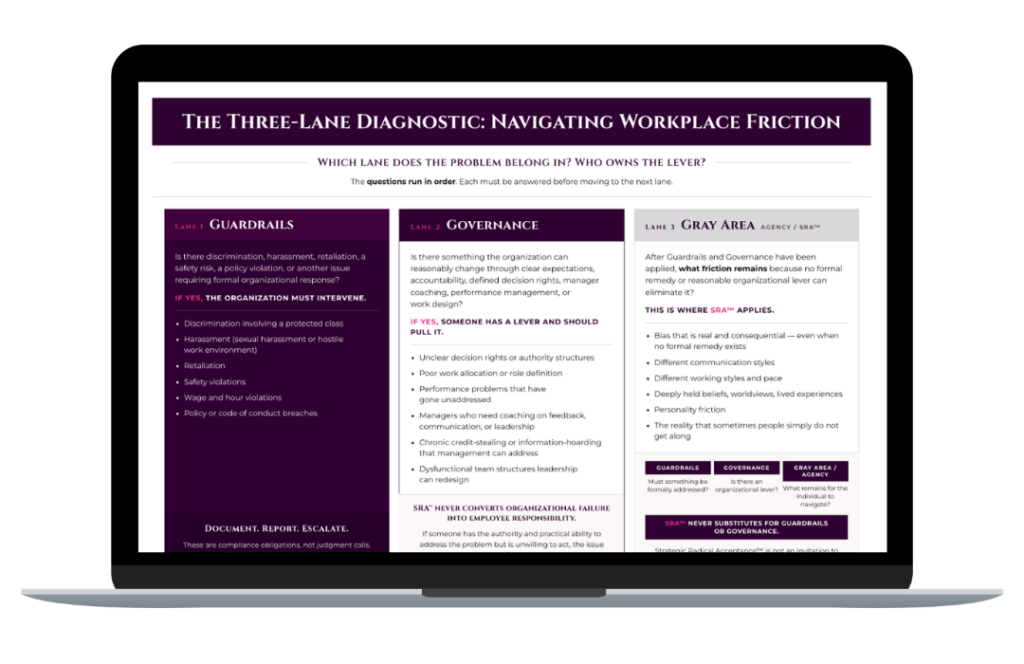
Strategic Radical Acceptance™ is built on a diagnostic I wish I had in that evaluation room. It starts with one question about any workplace situation: who actually has the lever?
Lane 1: Guardrails. Is there discrimination, harassment, retaliation, a safety violation, or a policy breach? If yes, the organization must act. SRA is not the tool for this lane. Employment law is.
Lane 2: Governance. Is there a defined organizational process, or someone with actual authority over this specific situation? In BigLaw, where authority over your career is often distributed across partners, this lane is frequently narrower than it appears. If a real organizational lever exists, it remains a Governance issue even when someone chooses not to pull it. If authority is genuinely diffuse and no one possesses a decisive lever (which is likely in BigLaw), you may already be moving into the Gray Area.
Lane 3: The Gray Area. What remains after the first two lanes have been honestly assessed? The friction that persists because subjective judgment shapes formal records, because someone who has never worked with you can nonetheless weigh in on your career, and because a perception does not have to be fair to have consequences. No rule was broken. No lever exists that would fix it. It is still real, and it is still yours to navigate.
The West Palm Beach dinner story was Gray Area. My mentor’s objection in that room was Governance at its best, and a person with standing using it. But she could not erase what had been written. She could only object to its being there. The rest was mine to navigate.
The Lever I Actually Had
Knowing which lane you are in does not make the situation easier. What it does is redirect your energy from the lever that does not exist toward the ones that do.
I could not make that partner’s original judgment fair. I could not retroactively change what had gone into my record. I now understood that the less someone knew about my work, the more weight a single interaction might carry because there was so little other information available to compete with it. What I could do, what I eventually learned to do, was become more intentional about what information I was putting into the system going forward.
I could not control every partner’s impression of me. I could become more deliberate about the signals I was sending to partners who did not know my work well enough to have much other data. I could make sure that when I declined something, I did not just answer the logistical question. I could manage the professional message at the same time.
That is not capitulation. That is sophistication. And it is the distinction that SRA is built on.
What I Want You to Take From This
If you are sitting with something right now that is not quite bad enough to report but too significant to ignore, run it through the three lanes honestly.
Is there a legal line being crossed? Use the process.
Is there a real lever, someone with actual authority who can and will act? If so, use it, and be honest with yourself about whether the lever is real or theoretical.
If what remains is friction you have to live with, that is the Gray Area. The work is not accepting that what happened was fine. It is accepting that the remedy you want does not exist, so that you can stop spending energy pursuing it and start identifying the leverage you do have.
Not every harm comes with a remedy. Not every unfair outcome comes with someone whose job it is to correct it. That does not make the harm imaginary. It changes the strategic question.
Once you know which lane you are actually in, the question stops being: Who should fix this?
It becomes: Given that this is true, where is my actual leverage now?
Strategic Radical Acceptance™. This is not Resignation. This is Liberation. And it’s Strategy.