
Early in my time with a new office, I was doing what every associate does when they arrive somewhere unfamiliar: building relationships. I had existing casework that carried over from another office, but I understood that over time my practice would need to root itself where I actually sat. That meant getting in front of the litigation partners, getting staffed on their matters, and demonstrating what I could do.
One of the more senior partners brought me into a client meeting. The client was an executive in a blue-collar industry, a project manager or operations leader, the kind of person who runs things on the ground and carries real authority without the polish of a corporate boardroom. I was the only woman in the room.
The partner cursed throughout the meeting. Freely and frequently. It did not bother me personally. But I was watching the client, and the client was uncomfortable. Not with the substance of the conversation. With the language, and I suspect with the fact that it was being used so casually in front of me.
After the meeting, I went to my supervisor, the leader of our litigation practice group, and I told him what I had observed. I was careful about how I framed it. I was not talking about my own discomfort, because I did not have any. I was talking about the client. I told him that the partner seemed unaware of how the language was landing, and that someone should probably mention it to him, because the client’s reaction was visible enough that it was a business issue, not just a style issue.
I thought that was the right thing to do. I thought I had handled it correctly.
What happened next taught me something I have never forgotten.
The relationship with that partner cooled. Noticeably and quickly.
I was not kept on the case. He found someone else to work it. And for the better part of the next decade, we did not work together again.
There was no conversation about it. No feedback. No moment where anyone said directly that raising the concern had been a mistake. There was just the absence of what had been there before. The staffing that stopped. The invitations that did not come. The easy collegial relationship that had been beginning to form, and then did not.
I want to be precise about what that was and what it was not.
It was not retaliation. Not legally. Retaliation, in the employment law sense, requires an adverse employment action connected to protected activity. Raising a professional conduct concern about a colleague’s language in a client meeting is not protected activity in the legal sense. And a partner choosing not to staff an associate on his matters, while it may cost the associate something real, likely does not meet the legal threshold for an adverse employment action that a court would recognize.
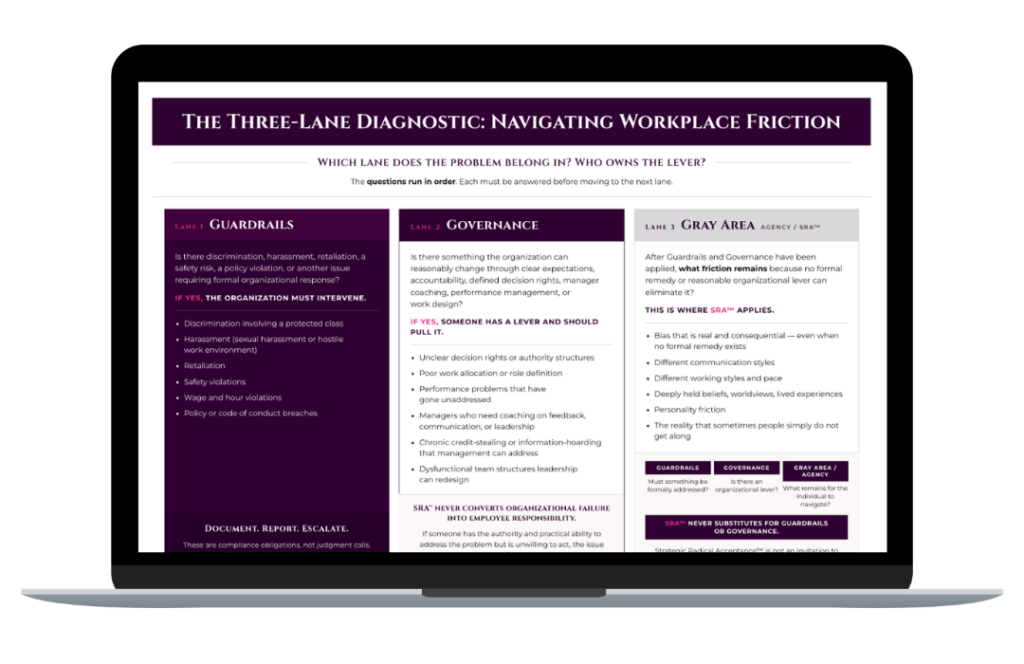
What it was, was the Gray Area in one of its most common and most costly forms.
A senior person felt criticized. Whether he processed it consciously or not, something shifted in how he saw me after that conversation. And the professional consequences of that shift, the matters I was not on, the relationships that did not develop, the decade of distance from a senior partner in my own office, were real and lasting even though they had no formal address.
Even if I had wanted to, I could not file a grievance. I could not raise it with HR. I could not have a conversation that would not just make things worse. There was no process built for what had happened, because what had happened was not a policy violation. It was a human being responding to feeling judged, in the way human beings do, and a system that had no mechanism for examining whether that response was fair.
The harm was diffuse. The accountability had nowhere to land.
And I had done everything right.
I want to say something directly to anyone who has lived a version of this story.
You are not imagining it.
The shift was real. The coolness was real. The matters that stopped coming, the easy rapport that never fully returned, the quiet recalibration of how someone saw you after you did something they did not like. All of it was real, and all of it cost something that will never appear on a performance review or a billing report.
And there is no clean address for it.
The person whose behavior changed may not have made a conscious decision. They may have simply felt criticized and responded the way people do when they feel criticized. By creating distance. There was no policy violation. No process designed to examine whether their response was proportionate or fair. No mechanism for restoring what was lost or even acknowledging that something had been lost in the first place.
The institution allowed it because the institution was not designed to see it.
That is not a reason to stop raising concerns that need to be raised. There are situations that require escalation regardless of the cost, and you will know them when you encounter them.
But it is a reason to understand, clearly and without illusion, what the informal economy of a large institution actually runs on. Relationships. Access. The accumulated goodwill of people who choose to bring you into rooms, put your name on matters, and speak for you when you are not present.
That economy has its own rules. They are unwritten, unenforceable, and consequential in ways the formal system will never acknowledge.
Knowing that is not cynicism.
It is clarity. And clarity is where strategy begins.
Strategic Radical Acceptance™. This is not Resignation. This is Liberation. And it’s Strategy.