
I spent 22 years defending employers against employment claims.
That means I sat across the table from employees who genuinely believed they had been wronged, and my job was to demonstrate, through discovery and depositions and motions practice and sometimes trial, that the law did not give them a remedy for what they experienced.
What I watched from that seat was not a story about bad employers and good employees. It was more complicated than that. It was a story about a gap. A gap between what people experienced at work, what they believed their organizations owed them, and what the formal system was actually built to address.
I watched that gap cost employees years of their professional lives and significant personal capital pursuing remedies the system was never designed to provide. And I watched it cost organizations millions of dollars, enormous leadership bandwidth, and serious cultural damage managing situations that should never have reached a formal process in the first place.
The gap has a name. And it is not unique to any one company or industry or moment in time.
But something happened after 2020 that made it wider, more visible, and more expensive than it has ever been.
What HR Has Been Asked to Carry
HR is a sophisticated and essential organizational function. At its best, it manages the full arc of the employment relationship: recruiting and retaining talent, building compensation structures, developing people, shaping culture, and yes, ensuring the organization operates within the boundaries of the law. The HR professionals I encountered across two decades of employment litigation were, almost without exception, serious, capable people doing a genuinely difficult job.
What happened after 2020 was not that HR failed. It was that HR got handed a problem no formal process was ever built to solve.
In the wake of the social justice moment, organizations made sweeping commitments. To belonging. To psychological safety. To ensuring that every employee felt seen, heard, and valued. Those commitments were, in many cases, sincere. They were also functionally impossible to deliver through any existing organizational infrastructure, including HR.
And there was a more fundamental problem underneath the infrastructure gap: none of these commitments were ever defined or operationalized.
What does it mean, concretely and measurably, for an employee to feel “seen?” What is the organizational standard for psychological safety, and how does a manager know when they have met it? What does “belonging” look like in a performance review, a staffing decision, a client pitch list? These questions were rarely asked and seldom answered. The commitments were made in the language of aspiration, not accountability. And without definition, there was no way to build toward them, no way to measure progress, and no way to know when they had or had not been achieved.
What there was, instead, were expectations. Subjective expectations. And expectations without infrastructure are just disappointments waiting to happen.
Because here is what the formal system can do: it can enforce concrete policy, investigate complaints, address conduct that crosses a defined legal or behavioral threshold, and create consequences for violations. That is meaningful, important work.
What it cannot do is deliver on a promise that was never defined in the first place.
Why 2026 Makes This Harder Than It Has Ever Been
The 2020 moment created the expectations. 2024 began dismantling the infrastructure that was supposed to meet them.
Analysis of Russell 3000 companies found that DEI staffing declined roughly 15 percent from its mid-2022 peak. Programs were quietly defunded. Titles disappeared. Commitments that had been announced with considerable fanfare were walked back with considerably less. The message to employees was not explicit, but it was clear: the organizational investment in your sense of belonging was contingent on conditions that no longer existed.
But what that rollback also revealed is something that was always true but became impossible to ignore: organizations cannot create universal ideological comfort in a deeply divided world.
They can create policies. They can enforce behavioral standards. They can investigate violations and address conduct that crosses a legal threshold. What they cannot do is make people think the same way, share the same values, or extend the same good faith across the political, generational, and cultural divides that are now present in virtually every workplace in the country. We are operating in one of the most polarized, economically pressured, and generationally fractured environments in recent memory. The workforce reflects that. And no HR function, however well-resourced and well-intentioned, can resolve at the organizational level what the broader culture has not resolved at the societal level.
This is not an argument for resignation. It is an argument for precision.
Because here is what the data actually shows about what drives people out of organizations: MIT Sloan research found that a toxic culture is 10.4 times more predictive of attrition than compensation. Not 10.4 percent more predictive. 10.4 times. The interpersonal friction that HR has been handed but cannot fix is not a soft problem. It is an attrition problem, a productivity problem, and a talent pipeline problem with measurable financial consequences.
The question is not whether the problem is real. It is whether the tools being used to address it were built for the job.
They were not.
What It Costs When the Wrong Tools Get Used
When employees don’t have a framework for distinguishing conduct that crosses a legal threshold from conduct that is costly, unfair, and entirely legal, everything escalates. Every difficult manager becomes a potential discrimination claim. Every critical performance review becomes a retaliation concern. Every interpersonal conflict becomes an HR investigation.
The cost to the individual is significant. Pursuing a formal process for a situation that lives outside the law’s reach is expensive in every sense: financially if legal counsel is involved, emotionally because naming and formalizing a grievance requires revisiting it at every stage, and professionally because the workplace relationship rarely survives intact. More importantly, the eighteen plus months spent in that process are eighteen plus months not spent building the leverage, the relationships, and the visibility that would actually move a career forward.
The cost to the organization is just as real, and far less often named.
HR bandwidth gets consumed by situations the formal process was never designed to resolve. Managers become reluctant to deliver honest feedback because every difficult conversation feels like a potential liability. Leadership time gets redirected from strategy to damage control. And the underlying friction that triggered the escalation in the first place almost never gets addressed, because the formal process was not built for that territory.
Corporate America has a structural blind spot here: organizations spend significant resources training their workforces on the narrow category of conduct that crosses a legal line, while leaving people entirely without tools for the vast majority of workplace friction that is exhausting, expensive, and completely legal.
We have taught people how to spot a lawsuit. We have not given them anything to navigate a Tuesday.
What Changes When People Have the Framework
This is where Strategic Radical Acceptance™ enters, and where the value proposition shifts from individual to organizational.
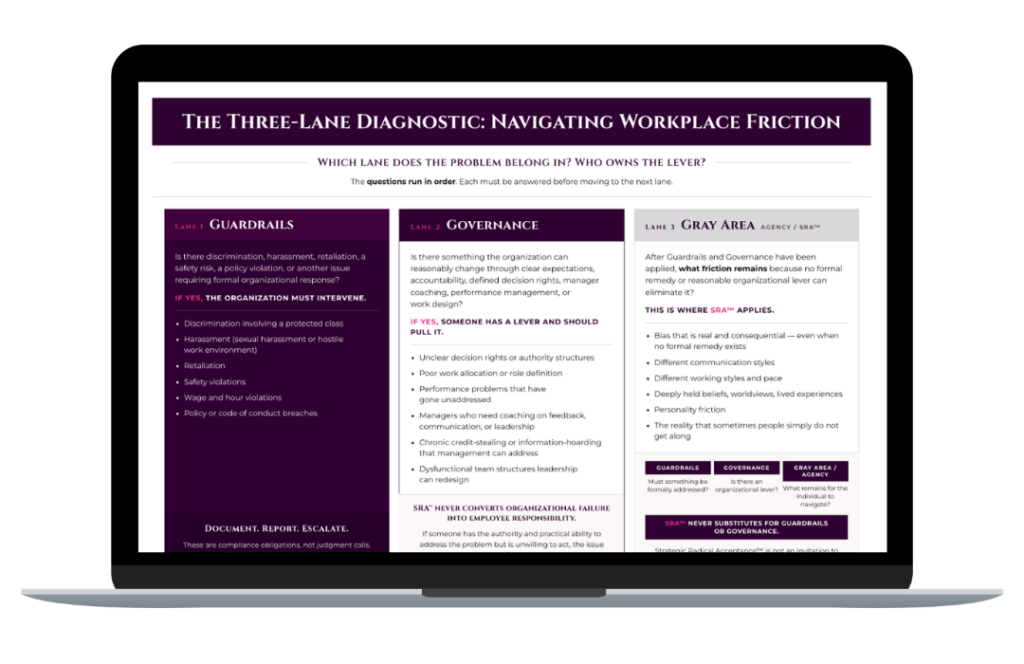
SRA begins by putting workplace problems in the right lane. Guardrails issues still require formal organizational response. Governance problems remain the organization’s responsibility when clearer expectations, better accountability, manager coaching, performance management, decision rights, or work design can reasonably improve the situation.
Only then do we reach the Gray Area: the friction that remains because no policy, process, or reasonable organizational lever can manufacture compatibility, eliminate every bias, resolve every difference in worldview, or make every difficult professional interaction disappear.
When employees and managers can distinguish between those three lanes, problems get routed more accurately. HR is not asked to investigate what belongs in direct workplace navigation, and employees are not asked to ‘accept’ something management actually has the power and responsibility to fix.
For HR, that creates clearer ownership. For employees, it creates agency. SRA™ gives them tools for the part of the professional experience they still have to navigate after the organization has done its part.
The friction does not disappear. The divided world does not become less divided. What changes is what people do with it.
That is not a mindset shift. It is a skill. And it is teachable.
Where This Leaves You
If you are an attorney or underrepresented professional reading this: the clarity this post offers is itself a form of power. When you stop waiting for the institution to deliver what it was never designed to provide, you can redirect that energy toward what the environment actually can deliver: opportunity, compensation, meaningful relationships, and the platform to build a career that changes trajectories.
If you are an HR leader, managing partner, or organizational decision-maker reading this: the question is not whether your people are experiencing this kind of friction. They are. The question is whether they have the tools to navigate it, or whether it is routing through your formal infrastructure at significant cost to everyone involved.
Strategic Radical Acceptance™ was built for exactly this gap.
Strategic Radical Acceptance™. This is not Resignation. This is Liberation. And it’s Strategy.